
This vignette describes the epidemiological model implemented in the ringbp R package.
Model Overview
The ringbp outbreak model is an individual-level branching process model to simulate an epidemic with individual-level non-pharmaceutical interventions (NPIs), namely: isolation, contact tracing and quarantine.
Isolation: Any infected individual that becomes symptomatic either self-isolates after an onset-to-self-isolation delay, or is tested and (if positive) isolated after an onset-to-isolation delay. The probability that a symptomatic case self-isolates rather than being tested is set by the user.
Contact tracing: If contact tracing is in operation the infectee can also be isolated as soon as they develop symptoms if the infector is isolating. Contact tracing in the ringbp model is a user-controlled parameter. Users can adjust the proportion of contacts ascertained by tracing between 0% (i.e. nobody is contact traced) and 100% (i.e. every symptomatic infector has all their contacts traced).
Quarantine: Users can turn on quarantine in the model. If quarantine is activated in the model then an infectee can be quarantined/isolated as soon as their infector goes into isolation, independent of whether they are symptomatic. Quarantine can be turned on or off in the ringbp model and affects the whole population.
In the scenarios that contacts are being traced in the model (i.e. the proportion of contacts ascertained > 0%), or quarantine is active, then the infectee is isolated at either the infector’s isolation time or an onset-to-isolation delay after their symptom onset time, whichever happens earlier. This means that in scenarios where contact tracing and quarantine are active it is possible that infectees are isolated before their infector. The infectee’s outcome cannot influence infector’s isolation, unlike infector’s isolation affecting infectees.
Disease natural history scenarios
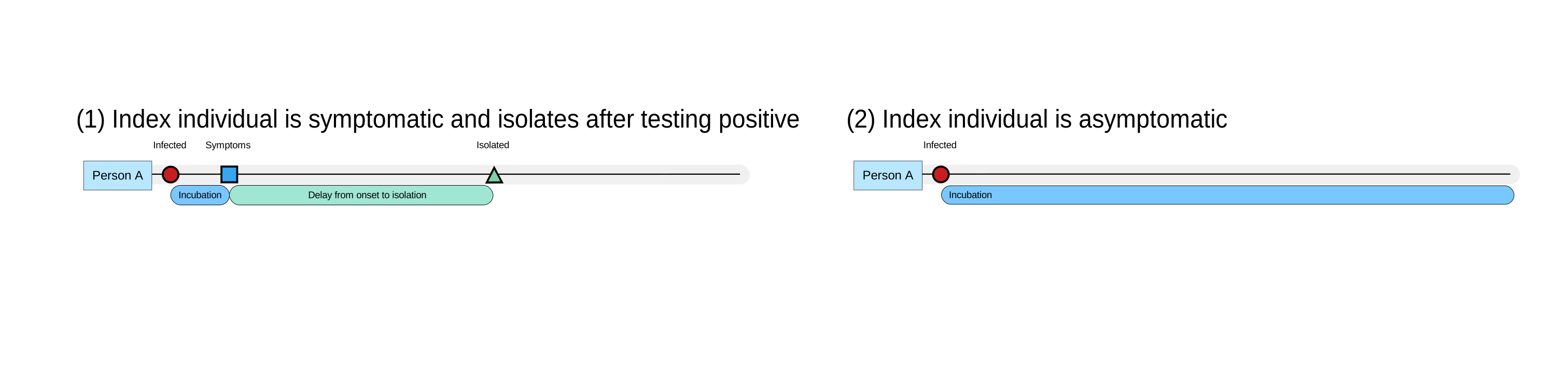
Scenarios (1) and (2) show situations where an index infector is symptomatic or asymptomatic, respectively. Asymptomatic individuals are assumed to remain subclinical throughout the course of their infection. Scenarios (1) and (3) show situations where an index infector is symptomatic and isolates, in (1) they isolate after a positive test result, in (3) they self-isolate. The delay from symptom onset to isolation can be modelled separately for isolation after testing and self-isolation without testing.
Transmission scenarios with interventions
Different combinations of transmission timing and intervention effectiveness produce distinct outcomes. The scenarios below illustrate how isolation and contact tracing interact with disease transmission in the model. The first two scenarios represent an index case that does not infect anyone. All other scenarios illustrate infection from a primary case (Person A) to a secondary case (Person B).
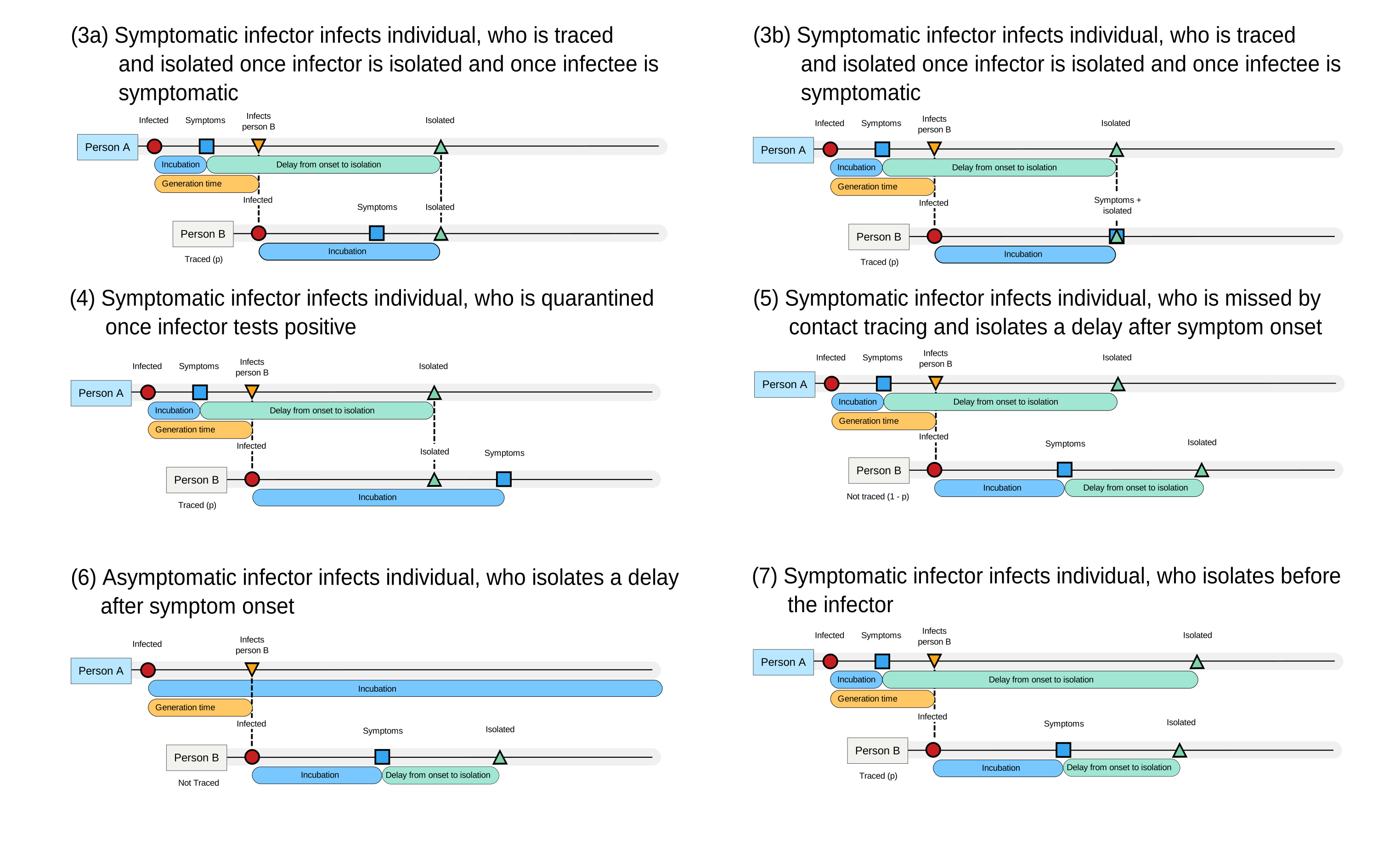
Scenarios (3a) and (3b) show what happens when a symptomatic infector transmits to a symptomatic infectee. The difference between (3a) and (3b) is that in (3b) the infectee develops symptoms later. As a result there is a short time delay between the infectee showing symptoms and then being isolated when the infector is isolated in (3a), whereas in (3b) the infectee is isolated as soon as they develop symptoms because the infector is isolated at the same time or before the infectee’s symptom onset.
Scenario (4) is the only scenario where quarantine is active. This scenario shows an example of an infectee being quarantined when the infector is isolated before the infectee’s symptoms develop.
Scenario (5) is where contact tracing is either not active (e.g. proportion of contacts ascertained = 0%) or contact tracing is active but the tracing missed this individual (the probability of a contact being missed is (1 - the proportion of contacts ascertained)). In this scenario the infectee is isolated after an onset-to-isolation delay from becoming symptomatic and also after the infector is isolated. The reason the infectee goes into isolation after the infector is because the contact tracing system does not notify the contact due to them being missed.
Scenario (6) shows what happens when an asymptomatic infector transmits. The symptomatic infectee is isolated after a delay from becoming symptomatic. The infectee cannot be traced as the infector is unknown to the contact tracing (or quarantine) system due to never showing symptoms.
Scenario (7) demonstrates where an infectee can be isolated before their infector is isolated because of variability in the onset-to-isolation delay. (This scenario is only possible when onset-to-isolation delays are drawn from a distribution, and cannot occur if all onset-to-isolation delays in the population are constant).
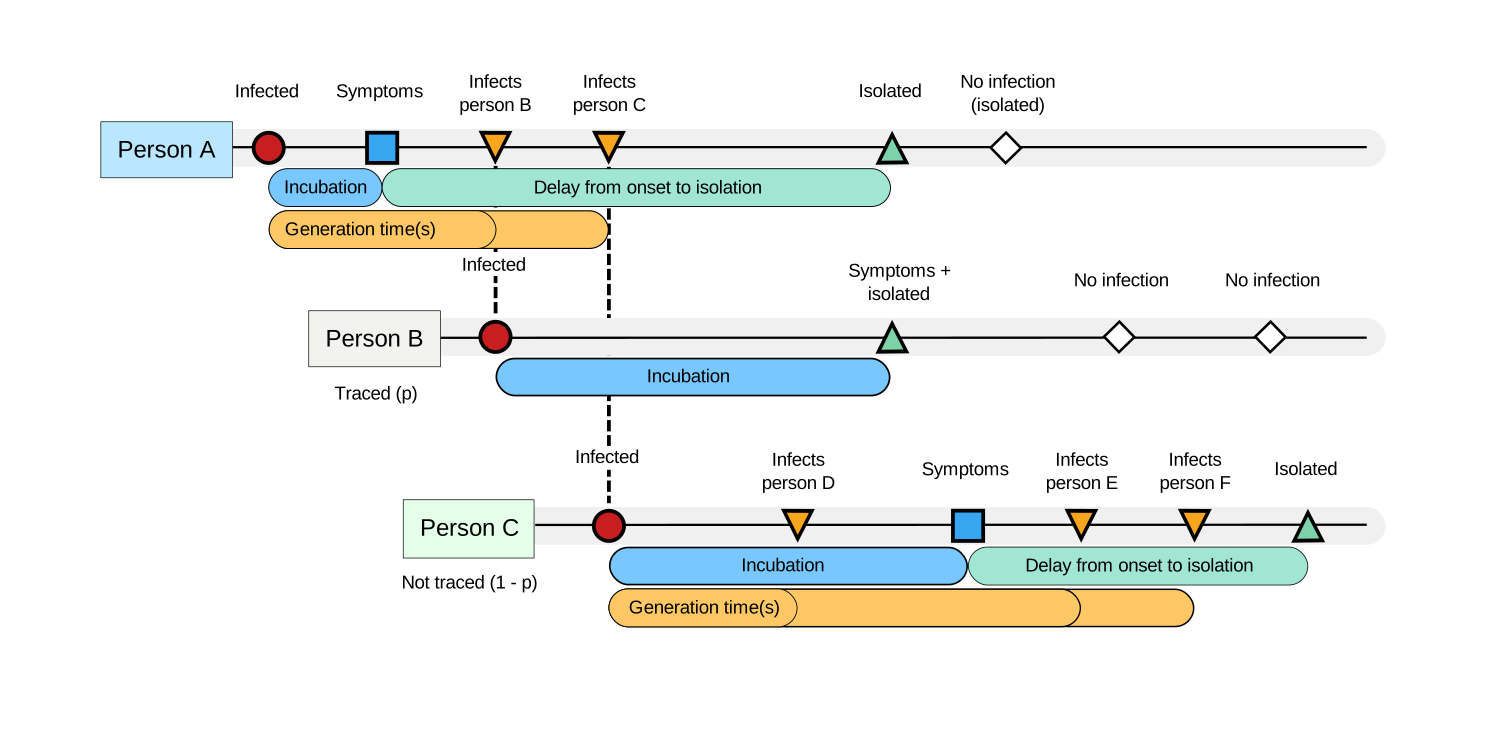
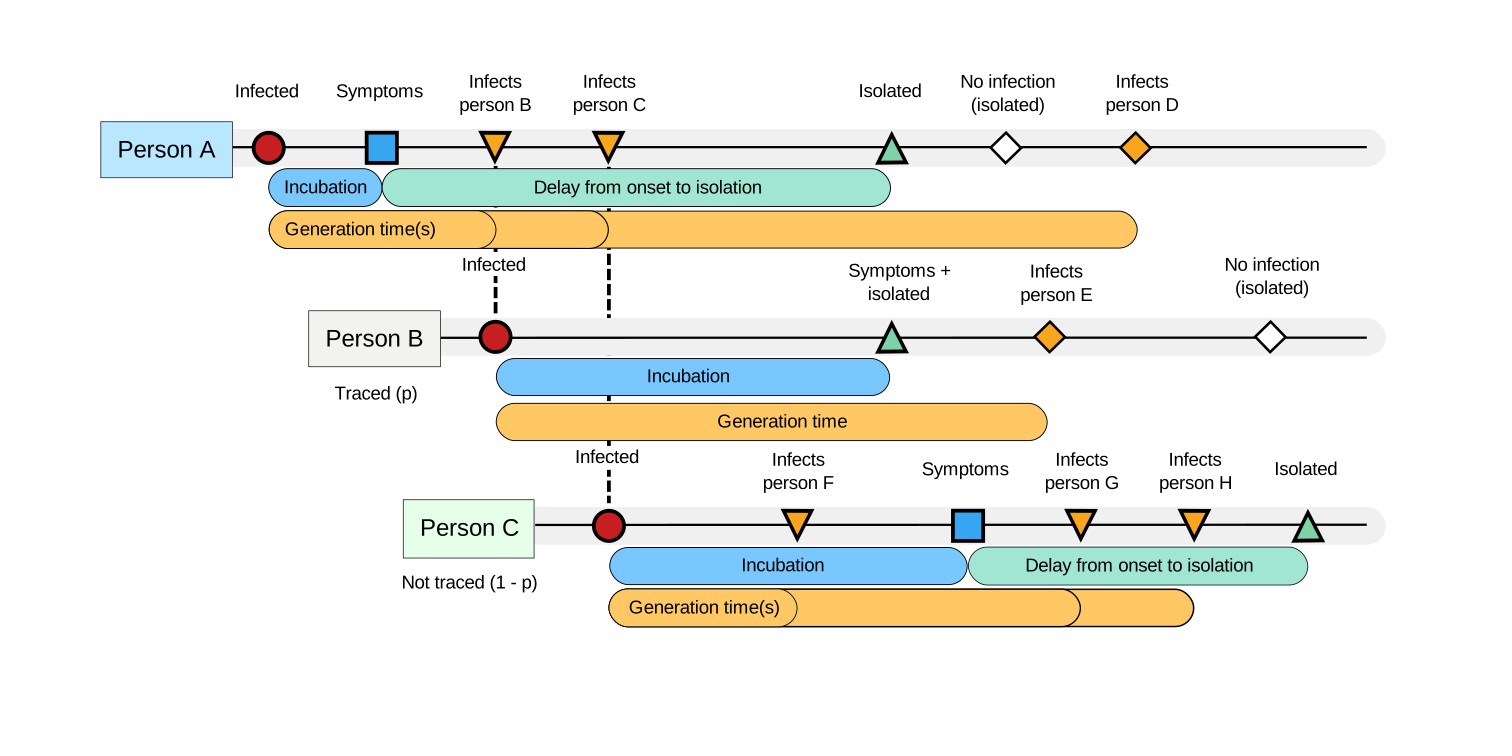
This schematic of the model shows an index infector (Person A) and two
individuals infected by Person A (Persons B and C). Each individual in
the 3-person outbreak shown has a time of infection (shown by the red
dot), a time of symptom onset (blue square), the time they infect others
(orange triangle) and the isolation time (green triangle). Some of the
time delays between events are also illustrated. The time between
exposure and symptom onset is the incubation period for the individual,
the time between symptom onset and isolation is the onset-to-isolation
delay, and the time between an individual being infected and infecting a
secondary case is the generation time.
The schematic also shows a scenario in which isolation completely prevents disease transmission. These are shown by diamonds for infection events that would have happened if the case had not gone into isolation. In other words, these are infections averted.
Presymptomatic transmission scenarios with interventions
All of the scenarios in the figure above assume that transmission occurs after the infector is symptomatic. The ringbp model can also model presymptomatic transmission. Below is another figure enumerating scenarios, but this time assuming that the infector infects the infectee before becoming symptomatic.
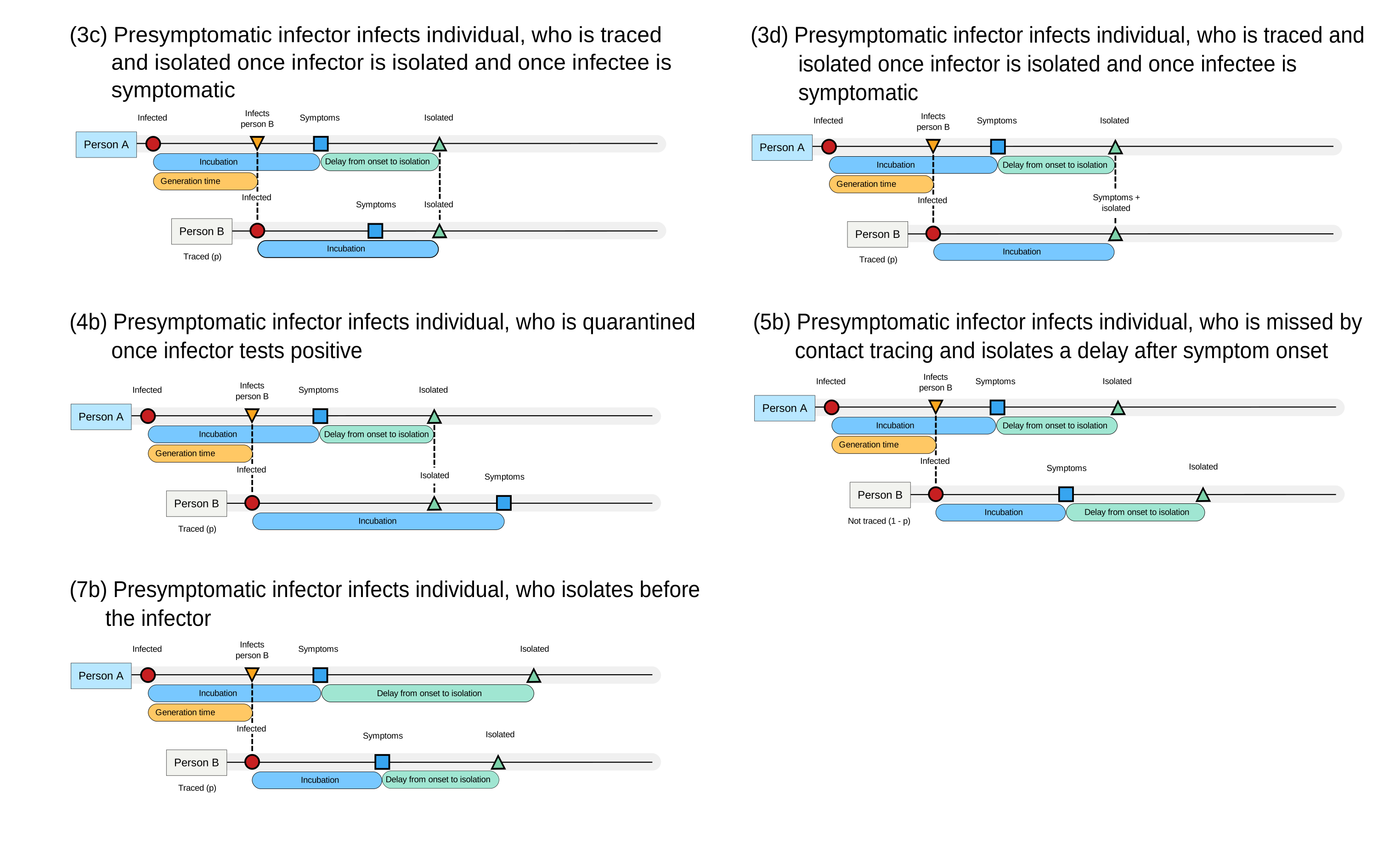
The scenarios in the presymptomatic transmission figure are linked by number to those in the postsymptomatic transmission scenarios figure.
Scenario (3c) and (3d) show the same contact tracing scenario as (3a) and (3b) in the previous figure, but assume transmission occurs before symptom onset.
Scenario (4b) shows the same active quarantine scenario as scenario (4). Scenario (4b) is the only presymptomatic transmission scenario that assumes quarantine is active.
Scenario (5b) is equivalent to scenario (5), illustrating what happens if an infectee is not traced because contact tracing ascertainment is not 100%, but for (5b) the transmission is presymptomatic.
Scenario (7b) corresponds to scenario (7) where the infectee is isolated before the infector due to the shorter onset-to-isolation delay.
Transmission in isolation
So far we have assumed that once cases are isolated they cannot transmit. However, the ringbp epidemic model allows the user to specify any offspring distribution for isolated individuals.
Infectees that are infected by someone isolating are not isolated until an onset-to-isolation delay after they become symptomatic.
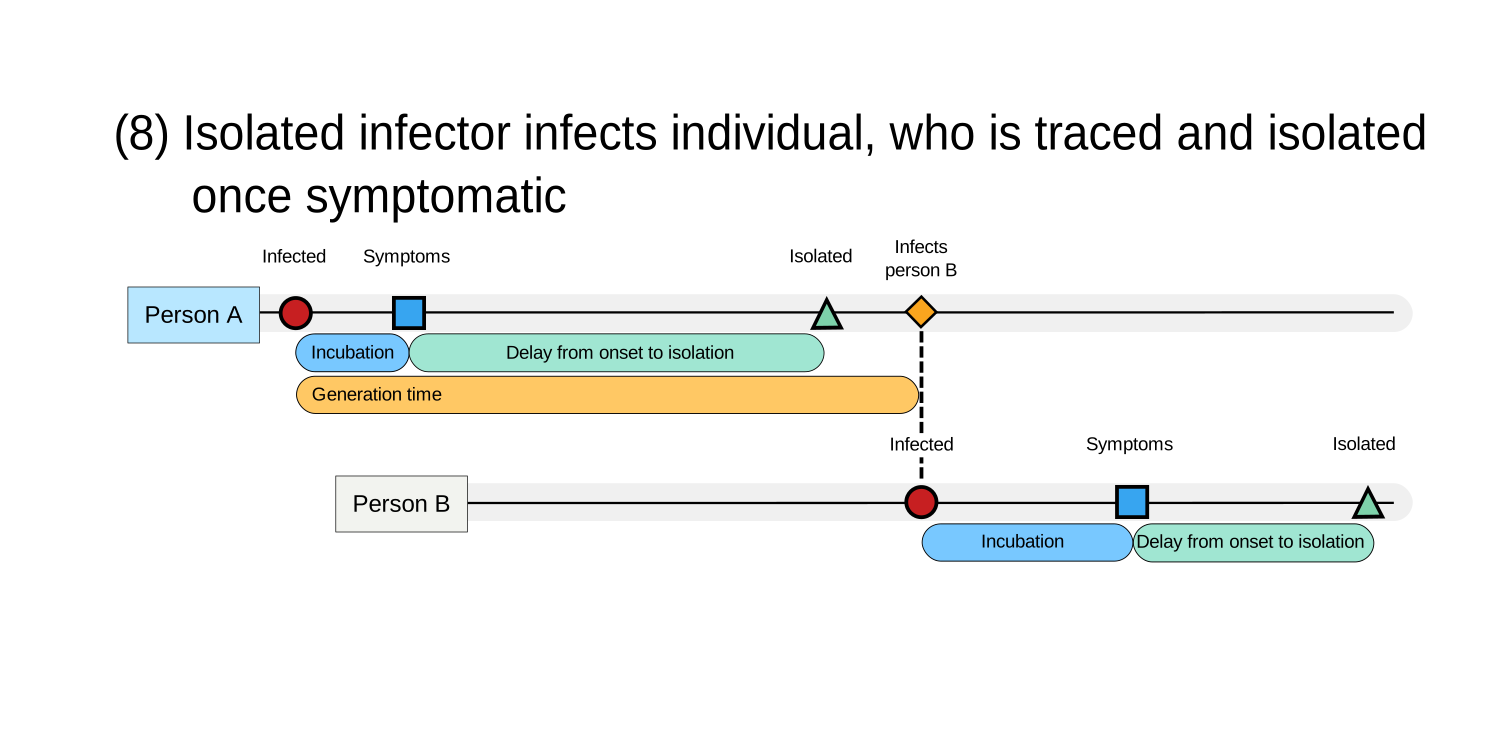
Scenario (8) shows the case where Person A infects Person B after Person A enters isolation, and Person B is isolated after a delay following symptom onset.
Below we show the same 3-person outbreak schematic as above, but this time isolation is assumed to be imperfect (or leaky) and the reproduction number in isolation is positive (). Person A and Person B transmit to Person D and Person E, respectively, from isolation.
Model parameters
The table below includes the ringbp parameters mentioned in this vignette that users can specify. Parameter values are given as examples and do not represent the default values.
| Epidemiological Parameter | ringbp Model Parameterisation |
|---|---|
| Incubation period distribution | delay_opts(incubation_period = \(n) rgamma(n = n, shape = 2, scale = 2)) |
| Onset-to-isolation delay distribution | delay_opts(onset_to_isolation = \(n) rgamma(n = n, shape = 2, scale = 2)) |
| Proportion of asymptomatic cases | event_prob_opts(asymptomatic = 0.5) |
| Proportion of presymptomatic transmission | event_prob_opts(presymptomatic_transmission = 0.5) |
| Contact tracing case ascertainment | event_prob_opts(symptomatic_traced = 0.5) |
| Quarantine | intervention_opts(quarantine = TRUE) |
In the ringbp model the generation time is not
parameterised, instead it is the result of the incubation period
distribution and the proportion of transmission that occurs
presymptomatically. The minimum generation time can be set by specifying
a latent_period in the delay_opts() function,
however, a non-zero latent period may alter the proportion of
presymptomatic transmission from what was set by the user.
Defined mathematically, for individual , let
Define the incubation period as
Let be a random variable where denotes the skew-normal distribution with location , scale , and skewness .
The generation time is defined as being distributed like , truncated to be at least .
Equivalently, its probability density function is where and denote the PDF and CDF of the skew-normal distribution, respectively.
For any infectee of we draw from and set their exposure time to
For the purposes of illustration, the scenarios presented in this
vignette include the fewest transmission events possible. The
transmissibility of symptomatic or asymptomatic cases in the community,
or cases in isolation in the simulation model can be set by specifying
the offspring distribution using the offspring_opts()
function.
The scenario_sim() function runs the
ringbp model for a specified number of replicates.
Further information
To see the exact implementation of transmission branching process
model with NPIs please see the code in the outbreak_step()
function.